|
|
|
|
|
|
|
|
|
|
|
|
|
|
 |
 |
 |
 |
 |
 |
 |
 |
 |
 |
 |
 |
 |
|
Session 15 (15 September 2015)
Composition in Art
The spatial property resulting from the arrangement
of parts in relation to each other and to the whole
In this session we looked at examples of how composition is used in art.
We looked at some of the techniques used in photography and painting and
the way composition leads the eye into, around, or out of a scene. Most
people naturally find certain arrangements pleasing to the eye, without
always knowing the reason for this, and this session aimed to show some
of the hidden elements behind such compositions.
Prior to the session, I asked everyone to bring a few objects relating
to their chosen themes and to consider their positioning and aesthetic
qualities before drawing or painting.
As people began to arrange their scenes, I realised that due to the nature
of sitting at tables, everyone was looking downwards at their objects.
I therefore suggested that raising the position of the items might improve
the perspective.
Top

Dianne
Dianne's subject for her composition around the theme of trees was quite
ambitious in its detail and perhaps simply drawing the mass and shadow
of its form would have been easier in the time available in the session.

Top
General observations
I would encourage the class to be a little bolder in their initial
mark-making. There is a tendency to seek perfection in representing
objects from the outset. This is also promoted by the materials used,
such as pencils, where blocking in the main shapes is not natural to
the medium being used.
My suggestion for the class would be to spend a few sessions starting
their work with chalk pastels, charcoal, or paint washes and then to
work back into images with mediums capable of adding detail - such as
pencil, ink pen, fine brush work, etc. This will produce more striking
imagery with greater depth.
Denise
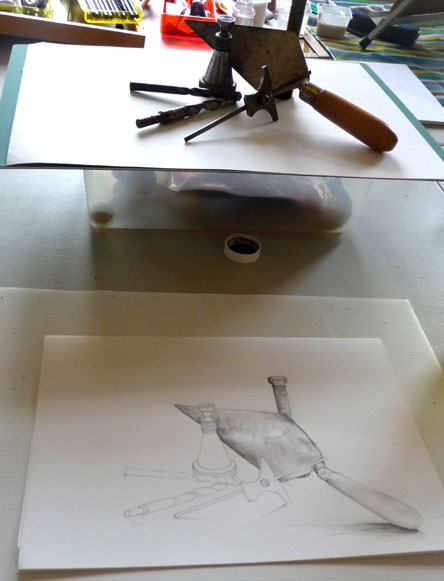
Denise arranged these tools as part of her buildings theme. We discussed
the positioning of the rear, central object, in relation to the trowel
point and experimented to see how moving the position of this object affected
the spacing or changed the feel of the arrangement.
Sue
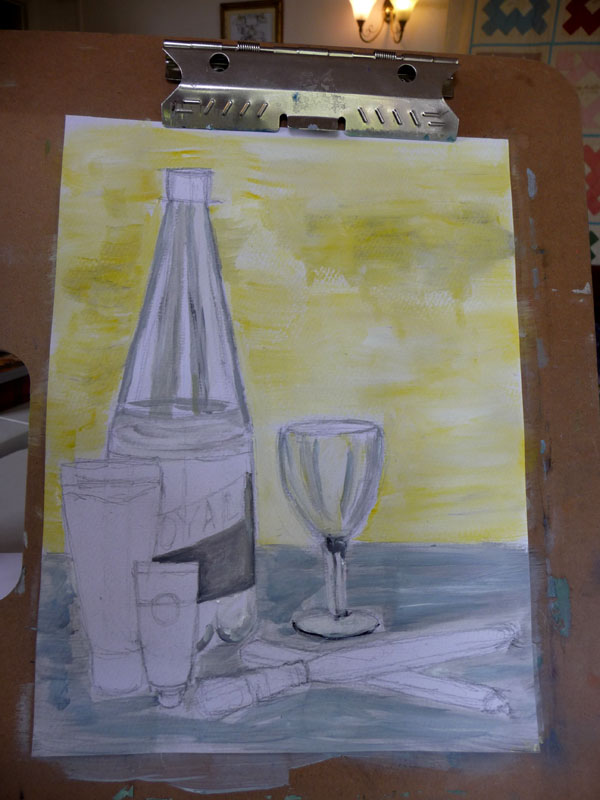
Sue's first visit to the group meant she hadn't been privy to choosing
a theme beforehand. However, she managed to put together this pleasing
arrangement which also fits quite well with the 'rule of thirds'. (Click
on image to see progression).