 |
|
|
|
|
|
|
|
|
|
|
|
|
|
 |
 |
 |
 |
 |
 |
 |
 |
 |
 |
 |
 |
 |
|

Sessions and ideas to try
1. How do we convey emotion and atmosphere through art? Could you draw or paint the following in an abstract way? (See the session)
An
emotion - joy, fear, sadness, etc.
A sound - high or low pitch, quiet or loud, etc.
A smell - something nice, horrible, etc.
A temperature - hot, cold, etc.
How do you, or could you, evoke a particular mood
in your drawings or paintings - whether figurative or abstract?

 click
image to enlarge
click
image to enlarge
Paint or draw a scene that conveys emotion and atmosphere. Your work can be figurative or abstract. (see more...) (See the sessions)
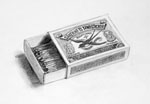
Draw a matchbox from an unusual angle or perspective. Scale up the size to fill an area of your paper.
You may represent your matchbox from exactly what you see - or add an element of mystery. (See a couple of examples by our artists)
6 & 7. Simple Card Sculptures.
Create some simple sculptural forms from geometric card shapes to explore form, space, light and shadow. You could use Anthony Caro's 'Promenade' as a starting point:
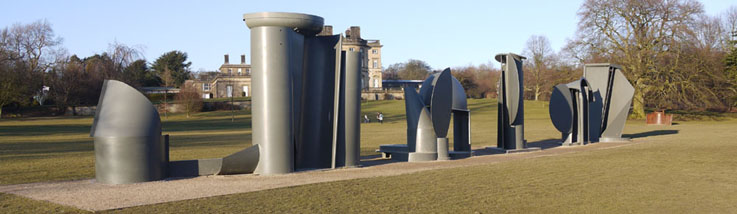
See some card sculptures made by the group here
See session reviews 5-8 here
Top
Try your skills at Trompe L'oeil (see examples in the techniques
section). Although it can be quite challenging, it really causes you to
concentrate. You have to look very closely and become quite precise in
your draughtsmanship - not to mention testing your ability to mix colours.
Having said that, it can be a highly enjoyable activity. Suggestion: See
if you can paint a 3-dimensional pen laying on your paper.
Try a bit of illusion. You can try this in
a small way by taking a piece of white card and folding it a few times,
standing it upright, and then sketching the outline of a word from one
view-point.


You don't have to do anything as complicated as the room above... but
it's an example of the idea.
Have a go at creating an illusion of depth.
Cut a piece of paper into a shape that might represent a hole. Lay it
on the table and create the impression that there is a real hole in the
table. What is in or through the hole?
Create a drawing or painting from listening to a
piece of classical or instrumental music. Think about any imagery
that the music creates in your mind. Perhaps you know something of the
history in the world when the piece was first composed. Does this evoke
other feelings that can be conveyed in your work?
Top
Opposites. Select an object to draw or paint, but instead of painting
to represent the material it is made from, paint it as if it were made
of an opposite material. For example: a hard object becomes a soft object.
Sculpture Ideas
Simple light sculpture experiments. Cut out
some shapes from pieces of card:
Bend the bottom of each shape and stick the pieces in a random fashion
on another piece of card, a plate, or straight onto a table, so that they
all stand vertically. Shine a torch through and around the sculpture in
various directions and observe the shadows created. Now try using more
than one torch. Notice the subtleties of shadow and light.
Take a coat hanger and dangle the pieces of card from cotton of different
lengths. Hang the sculpture a short distance from a white wall and, with
the room darkened, shine a torch through the sculpture so that its shadows
are projected onto the wall.
Take a piece of grease-proof [oven] paper or tracing paper and place it
in front of your card shapes. Shine a torch from behind so that the shadows
appear on the screen.
Take two or three torches and cover the lens of each one with a different
colour of transparent plastic. (You could use 'Quality Street' sweet wrappers
or similar). Shine the torches through the shapes and observe the shadows
on the table, wall, or screen. Notice how the colours blend and change
in subtlety and intensity.
Sketch Books
It's a good idea to have a sketch book to jot down thoughts and ideas,
scribbles, drawings, etc.
Cameras
Having a camera (or mobile phone with a camera) with you can be useful
for capturing images, objects, or scenes, that inspire you.
Collections
Most artists become avid collectors of resources for use in their work
- from items and objects (to draw and paint) to collections of all manner
of bits and pieces to use in their sculptures.
Top


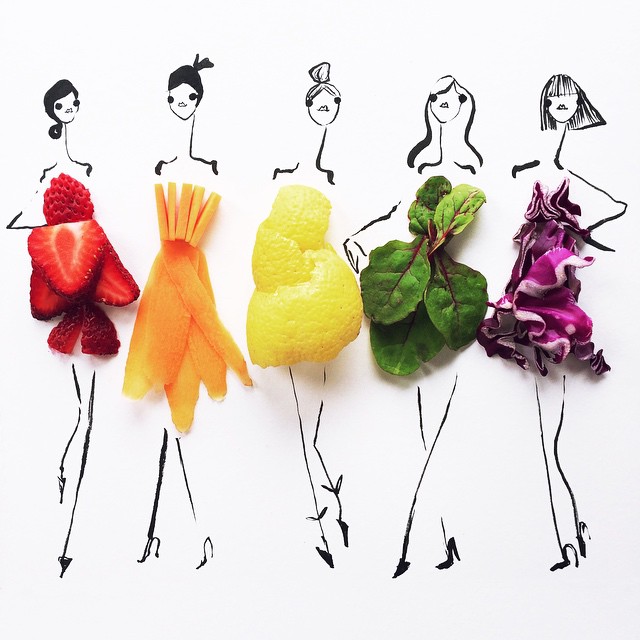
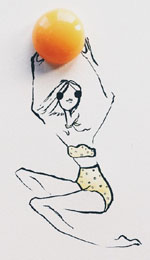
Fashion Illustrator,Gretchen Roehrs, Completes Her Dress Sketches With Food:
View more...
Also see a different technique for using plants on our 'forced perspective' page.
Top